Top Signs You Need Garage Door Service – Don’t Ignore These
A garage door that opens slower than it used to isn’t aging gracefully. It’s telling you the spring is losing tension, and you’ve got weeks, not months, before it gives out completely. The warning signs of a failing door are rarely subtle. They’re just easy to write off as quirks until the door drops, the spring snaps, or the opener burns out. This guide walks through what those quirks actually mean so you can act before a small fix turns into a big one. If you’d rather not climb a ladder to investigate, call (833) 508-9169.
Why Garage Door Problems Get Missed
Most Weequahic homeowners use their garage door twice a day, sometimes more, and that repetition is exactly what makes decline hard to notice. A door doesn’t fail all at once. It drifts. It slows by a second here, adds a rattle there, hesitates near the top of its travel. Each change is small enough to dismiss, so the door keeps running on borrowed time until one morning it won’t move at all.
The other reason problems hide is that garage doors are heavy, tensioned machinery that looks simple from the driveway. You see a panel and a button. What’s actually happening is a spring system, a balance of cables and drums, and an opener motor, all working together. When one part weakens, the others quietly compensate. That compensation is the sound or slowness you notice, and it’s why we treat every complaint as a diagnostic clue rather than a nuisance.
Below are the signals worth paying attention to. Some are obvious. A few are the ones most people miss entirely.
1. The Door Is Slower, Choppier, or Louder Than It Was Six Months Ago
Your door is measuring its own decline. A door rising smoothly and at a steady pace is in balance. One that lags, jerks, or sounds like it’s grinding through gravel is under strain, and the change usually traces back to one of three things:
- Spring tension loss: Torsion and extension springs weaken gradually with every cycle. As tension drops, the opener has to lift more of the door’s weight on its own.
- Roller and hinge wear: Nylon rollers flatten and steel rollers dry out. Hinges loosen. Friction builds up and the door gets harder to move.
- Track misalignment: A track knocked slightly out of plumb, sometimes by a bumped car or just settling, makes the door rub as it travels.
Here’s the part that matters: a slower door isn’t lazy, it’s loaded. When the opener is fighting a mechanical problem, the motor and gear assembly wear faster, and what started as a spring or roller issue becomes an opener replacement too. Catching the slowdown early is the cheapest repair in the whole cycle. For Weequahic homeowners, this is the single most useful thing to watch for.
2. Watch the Door Rise: The Asymmetry Test
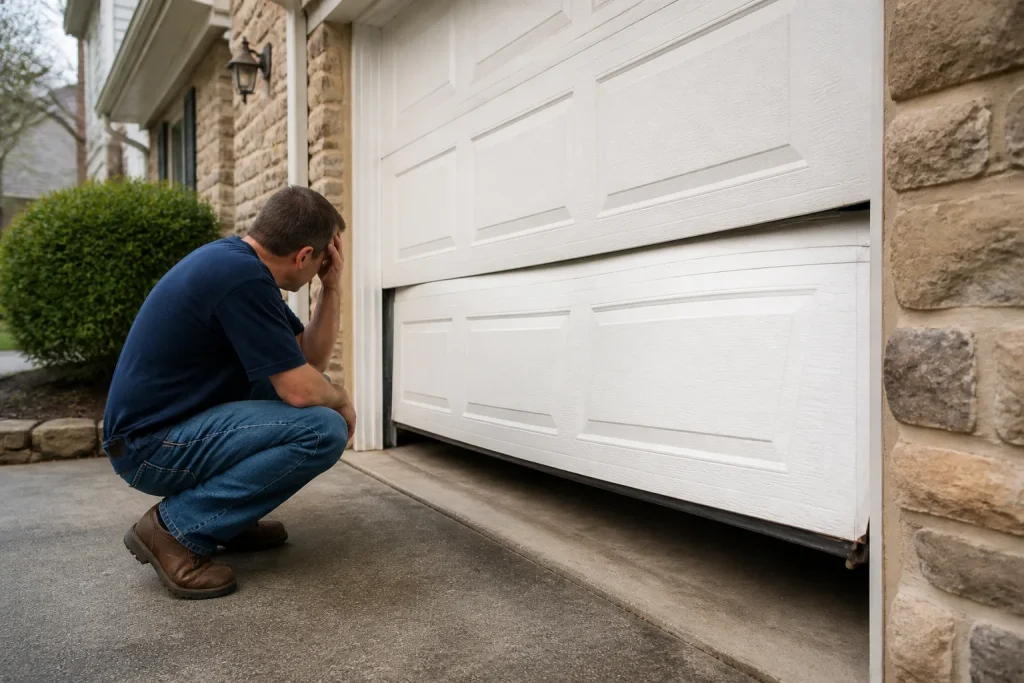
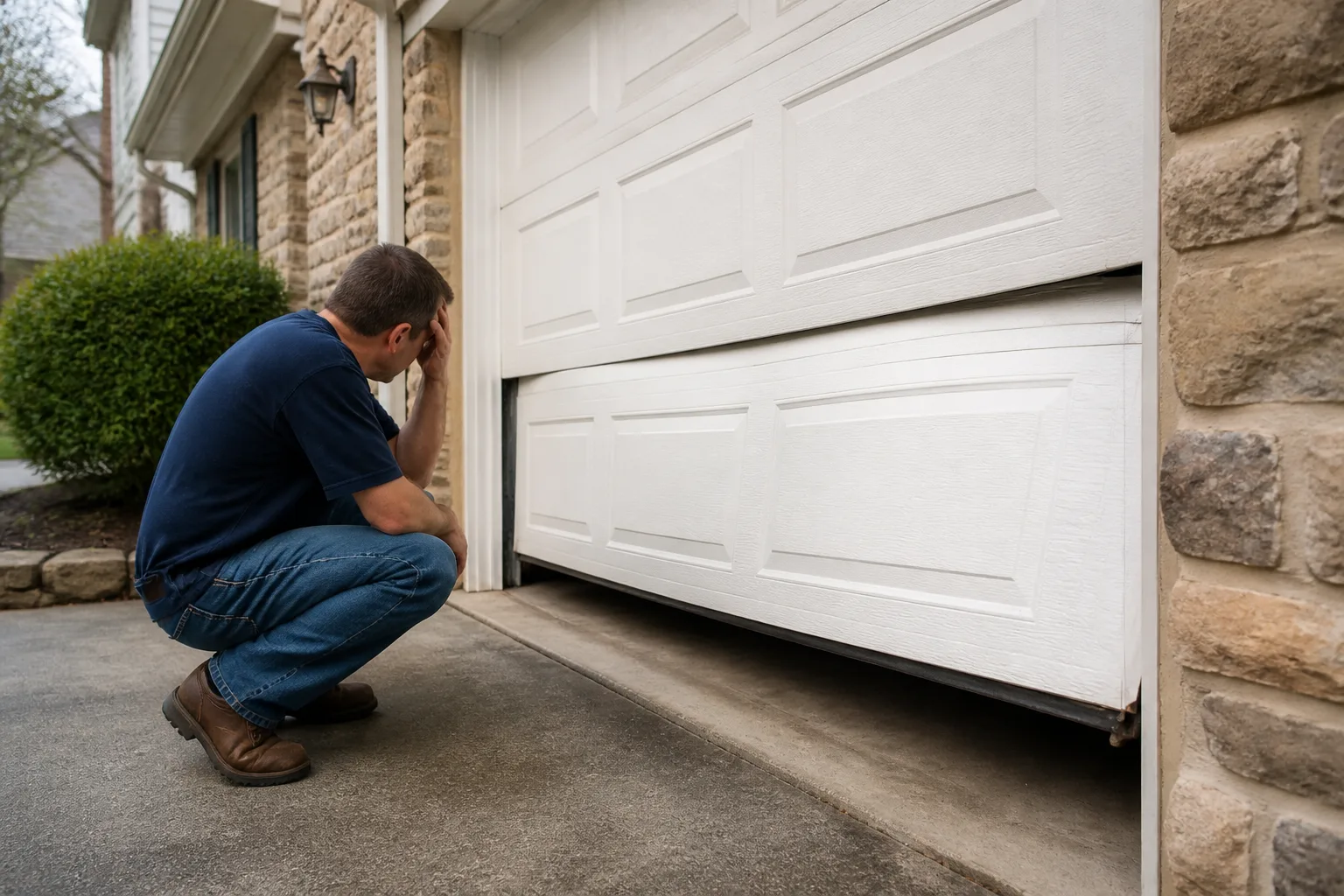
Stand back and watch your door open from a few feet away. Both sides should rise at the same rate, with the door staying level across its width. If one side climbs faster than the other, or the door visibly tilts during travel, you have uneven cable tension, and that’s the clearest early warning of a cable or drum failure.
Cables and drums are what keep a tensioned garage door even. When one cable stretches, frays, or slips on its drum, the door loads unevenly. Left alone, this can jump the cable off the drum or snap it, and a door hanging on one cable is genuinely dangerous. Cables are under extreme tension and are not a DIY item. If you see tilt, uneven rise, or a cable that looks slack or frayed, stop using the door and have it checked.
This test takes ten seconds and needs no tools. In our experience, it’s the check most homeowners never perform, which is a shame, because it’s the one that catches a serious problem before it becomes an emergency.
3. The Opener Is Overheating or Cycling More Than It Should
Openers are designed to lift a balanced door. When the door’s balance goes off, the motor picks up the slack, and that shows up in behavior you can hear and see:
- The motor sounds labored, louder than it used to during a lift.
- The opener stops partway and needs a second press to finish.
- The unit shuts down for a stretch after several cycles, a built-in overload protector doing its job.
- Lights dim or flicker when the opener starts, a sign it’s drawing more power than a healthy lift requires.
- The door reverses on its own halfway up, the safety system reacting to extra resistance.
Every one of these is the motor compensating for a mechanical problem it shouldn’t have to fight. The fix is usually the mechanism, not the opener. On a brand like Genie or LiftMaster, the opener itself may still be perfectly healthy; it’s just being asked to do the spring’s job. If your opener has started this pattern, a proper diagnosis will tell you whether you’re looking at an garage door opener repair or a balance problem in the door. Getting it fixed right the first time keeps a good opener running instead of replacing it prematurely.
4. Rust, Wear, and the Threshold Between Aging and Failing
Some rust is cosmetic. Some is structural, and the difference matters. Here’s how to tell them apart:
- Surface rust: A light orange film on paint, usually on the bottom panel where splash and grit collect. Cosmetic. Clean and repaint and it’s done.
- Structural compromise: Pitting, flaking paint over bubbling metal, or rust concentrated on a spring, cable, or hinge pin. On tension-bearing parts, rust eats into the metal itself and weakens it. A rusted spring coil or a corroded cable end is a failure waiting on a date.
Check the springs at the top of the door, the cables running up the sides, and the hinges where the panels join. Surface aging on the door skin is normal and doesn’t stop the system working. Rust on the hardware is different, and it’s the wear threshold that should prompt service. We’ve seen doors wired to Clopay and Amarr panels where the paint held up fine while the springs above it were quietly corroding, so look at the hardware, not just the face.
5. The Sign Almost Everyone Misses: The Door Won’t Stay Put
This is the one. Disconnect the opener, lift the door to about halfway, and let go. A correctly balanced door stays where you left it. If it slides down on its own, or drops the moment you release it, the spring balance is off, and the opener isn’t weak. The springs are supposed to carry the door’s weight; when they can’t, the door falls and the motor fights to hold it. That’s why the opener seems tired when the real problem is the balance system.
Don’t confuse this with an opener that’s lost its setting or a remote that needs a battery. A door that won’t hold position has a spring or balance issue, and springs are the most dangerous component on the whole door. They’re under enough tension to cause serious injury if released wrong. This is the point where a call to a professional is the right move, not a project. Our team works with Garage Door Repair Weequahic as a full-service garage door specialist, and spring repair is a dedicated part of what we do for exactly this reason.
When to Call a Pro
Some checks are safe to do yourself: watch the door rise for tilt, listen for new noise, look for rust on the hardware, run the balance test with the opener disconnected. Everything past that, especially anything touching springs, cables, or drums, belongs to a trained technician. Those parts are tensioned machinery, and a wrong move with a spring or a cable can cause serious harm. Know your limits and let someone who works on these every day handle the dangerous parts.
If you’re in Weequahic and the door is slowing, tilting, or won’t stay put, we offer free estimates and can diagnose what’s actually wrong instead of guessing. If it’s urgent, our garage door repair and emergency service are built for exactly these situations, because a stuck door isn’t something you can wait a week on. And if the door has simply reached the end of its life, a garage door installation from Wayne Dalton or another major line gives you a clean start. Our technicians bring up to 8 years of experience and work on the brand you already have.
The Bottom Line
Your garage door tells you what’s wrong long before it quits. Slowness is load, not age. A tilted rise means uneven cable tension. An opener that overheats or cycles is fighting a balance problem. Rust on springs and cables is structural, not cosmetic. And a door that won’t stay put means the spring balance is off. Catch these early and you’re looking at a small repair; ignore them and you’re scheduling an emergency.
If you’re in Weequahic and need help, Garage Door Repair Weequahic offers free estimates. Call (833) 508-9169 and we’ll get it fixed right the first time.
Frequently Asked Questions
The earliest signs are a door that opens slower or louder than it did months ago, one side rising faster than the other, and an opener that labors or stops partway. If you notice any of these, have the door checked before the strain spreads to the opener or the cables.
Disconnect the opener, lift the door halfway, and let go. If it won’t stay in place and slides down, the spring balance is off. A loud bang, a visible gap in a torsion spring, or a door that suddenly feels very heavy also point to a spring problem. Call a professional; springs are dangerous to handle.
No. A door that has slowed down is carrying more load than it should, and the strain only grows. Left alone, a slowing door typically leads to opener failure or a spring break. Getting it looked at early keeps the repair small.
Light surface rust on the door panels is cosmetic and easy to address. Rust on the springs, cables, or hinge pins is different. Those parts carry tension, and corrosion weakens them. If the rust is on the hardware rather than the paint, have it checked.
If the door is stuck open, hanging unevenly, or a spring or cable has visibly failed, call for emergency service. A door in that condition is unsafe to operate. For slowing, noise, or wear you’ve noticed over time, a regular appointment gets it fixed before it becomes urgent.
Written by the team at Garage Door Repair Weequahic.
Need Garage Door Help?
Call Garage Door Repair Weequahic - the local pro we connect you with is licensed and insured, here with fast after-hours help in Weequahic.
(833) 508-9169